
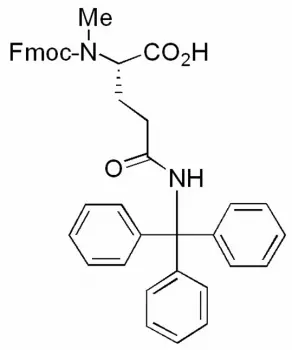
Fmoc-N-Me-Gln(Trt)-OH
$360.00
| Catalog Number | FQ2161 |
| Chemical Structure |  |
| CAS Number | 1632075-13-8 |
| Molecular Weight | 624.72 g/mole |
| Formula | C40H36N2O5 |
Description
Fmoc-N-Me-Gln(Trt)-OH (CAS 1632075-13-8): Advanced SPPS Reagent & Technical Guide
In modern solid-phase peptide synthesis (SPPS), chemical biology, and peptidomimetic engineering, controlling peptide backbone conformation and enzymatic stability represents a primary design goal. Incorporating $N^\alpha$-methylated amino acid derivatives allows synthetic chemists to eliminate amide hydrogen-bond donors, disrupt interchain self-assembly, and improve biological half-life. Among these specialized reagents, Fmoc-N-Me-Gln(Trt)-OH (CAS 1632075-13-8) serves as an essential orthogonal building block for introducing backbone-modified glutamine residues into complex peptide sequences.
Glutamine contains a polar side-chain primary amide group that is susceptible to dehydration, nitrile formation, or deamidation if unshielded during synthesis cycles. For research facilities seeking to evaluate Fmoc-N-Me-Gln(Trt)-OH CAS 1632075-13-8 price structure and secure a validated buy Fmoc-N-Me-Gln(Trt)-OH supplier, acquiring analytical-grade reagents from amino asylum ensures high coupling efficiency, structural fidelity, and reproducible batch-to-batch performance.
What is Fmoc-N-Me-Gln(Trt)-OH (Fmoc-N-methyl-L-glutamine(Trt))?
Fmoc-N-Me-Gln(Trt)-OH, chemically designated as $N^\alpha$-(((9H-fluoren-9-yl)methoxy)carbonyl)-$N^\alpha$-methyl-$N^\gamma$-trityl-$L$-glutamine, is an $N^\alpha$-methylated, side-chain protected amino acid derivative engineered for standard Fmoc/tBu SPPS protocols.
Substituting a methyl group onto the $\alpha$-amino nitrogen converts a standard secondary amide linkage into a tertiary amide within the peptide backbone. This modification alters local steric parameters, removes a hydrogen-bond donor site, and shifts the cis/trans amide bond equilibrium toward defined secondary structures.
                 [ Fmoc-N-Me-Gln(Trt)-OH Chemical Architecture ]
                                        │
        ┌───────────────────────────────┼───────────────────────────────┐
        ▼                               ▼                               ▼
[ Base-Labile Fmoc ]           [ N-Methylated Nitrogen ]       [ Acid-Labile Trt Amide Shield ]
(Alpha-Amine Protection)       (Eliminates H-Bond Donor)       (Gamma-Amide Side-Chain)
        │                               │                               │
        ▼                               ▼                               ▼
 Deprotects via 20%             Prevents Beta-Sheets &          Prevents Dehydration &
 Piperidine in DMF              Resin Aggregation               Deamidation Side-Reactions
Molecular Architecture & Chemical Identity of CAS 1632075-13-8
The chemical parameters of CAS 1632075-13-8 define its utility as a core building block for custom peptide modification:
Chemical Specifications Reference:
• Full Chemical Name: N-alpha-(((9H-fluoren-9-yl)methoxy)carbonyl)-N-alpha-methyl-N-gamma-trityl-L-glutamine
• CAS Registry Number: 1632075-13-8
• Common Nomenclature: Fmoc-N-methyl-L-glutamine(Trt)
• Abbreviated Name: Fmoc-N-Me-Gln(Trt)-OH / Fmoc-MeGln(Trt)-OH
• Molecular Formula: C40H36N2O5
• Molecular Weight: 624.74 g/mol
• Protect Group Matrix: N-alpha (Fmoc, base-labile), Gamma-Amide (Trityl/Trt, acid-labile)
• Physical State: Off-white to white powder
• Storage Parameters: Refrigerated (-20°C to 4°C), desiccated, sheltered from light
Orthogonal Protection Chemistry: Fmoc and Trityl (Trt) Amide Shielding
Base-Labile N-alpha Fmoc Deprotection Dynamics
The 9-Fluorenylmethyloxycarbonyl (Fmoc) group protects the $N^\alpha$-methylated amine during storage and coupling steps. Deprotection proceeds efficiently via base-catalyzed $E1cB$ elimination using $20\%$ piperidine in DMF, yielding a secondary $N^\alpha$-methylamine ready for subsequent elongation cycles without affecting acid-sensitive side-chain protecting groups.
Acid-Labile Side-Chain Trityl Protection and Suppression of Deamidation
The primary amide on the glutamine $\gamma$-carbon is shielded by a bulky Triphenylmethyl (Trityl / Trt) group. This bulky group prevents side reactions during peptide assembly, such as base-catalyzed dehydration to cyano side chains or cyclization into glutarimide structures. The Trt group remains intact during base deprotection steps and is removed during final trifluoroacetic acid (TFA) cleavage.
| Property / Parameter | Unmodified Fmoc-Gln(Trt)-OH | Fmoc-N-Me-Gln(Trt)-OH |
| CAS Registry Number | 132327-80-1 | 1632075-13-8 |
| Backbone Amide Hydrogen | Present ($\text{-NH-}$) | Absent ($\text{-N(CH}_3\text{)-}$) |
| Backbone Hydrogen Bonding | High (Prone to aggregation) | Disrupted (Chain Disrupter) |
| Proteolytic Resistance | Standard | Enhanced (Protease Resistant) |
| Side-Chain Protection | $\gamma$-Amide Trityl ($\text{Trt}$) | $\gamma$-Amide Trityl ($\text{Trt}$) |
Applications of Fmoc-N-methyl-L-glutamine(Trt) Bulk Manufacturer Reagents in SPPS
                            [ SPPS Assembly Kinetics ]
                                        │
        ┌───────────────────────────────┴───────────────────────────────┐
        ▼                                                               ▼
[ Unmodified Sequence Assembly ]                             [ N-Methylated Insertion ]
        │                                                               │
        ▼                                                               ▼
[ Interchain H-Bonded Beta-Sheets ]                          [ Steric Backbone Disruption ]
        │                                                               │
        ▼                                                               ▼
[ Premature Termination / Low Yield ]                        [ Solvated Resin / High Coupling Yield ]
Backbone Methylation and Elimination of Beta-Sheet Self-Assembly
During long-chain SPPS, peptide chains often establish interchain hydrogen bonds between backbone amide protons ($\text{-NH-}$) and carbonyl oxygens ($\text{-C=O}$). This interaction can cause hydrophobic $\beta$-sheet aggregation on the resin support, shrinking resin matrix pores and limiting reagent access to the terminal amine.
Utilizing building blocks sourced from a verified Fmoc-N-methyl-L-glutamine(Trt) bulk manufacturer removes the amide hydrogen at the target locus. Inserting Fmoc-N-Me-Gln(Trt)-OH breaks up local $\beta$-sheet secondary structures, preserving resin swelling and improving step-wise coupling yields in difficult sequences.
Enhancing Peptide Pharmacokinetics: Proteolytic Resistance and Metabolic Stability
$N^\alpha$-methylation provides defined pharmacokinetic advantages in peptidomimetic design:
-
Enzymatic Shielding: The $N^\alpha$-methyl group sterically blocks cleavage by serum endopeptidases and exopeptidases, increasing compound half-life in biological assays.
-
Membrane Permeability: Removing a polar hydrogen-bond donor lowers the desolvation energy barrier, aiding passive trans-epithelial and trans-mucosal transport across biological membranes.
Methodological Protocols: What Is the Coupling Procedure for Fmoc-N-Me-Gln(Trt)-OH?
Overcoming Steric Hindrance During Hindered Amide Bond Formation
When investigating what is the coupling procedure for Fmoc-N-Me-Gln(Trt)-OH, synthesis teams must account for two distinct steric challenges: coupling Fmoc-N-Me-Gln(Trt)-OH onto a growing resin-bound amine, and coupling a subsequent amino acid onto the sterically hindered $N^\alpha$-methylamine of Gln(Trt).
Optimized Coupling Parameters for Fmoc-N-Me-Gln(Trt)-OH:
1. Primary Activation System: HATU (5 eq) / HOAt (5 eq) or COMU (5 eq) with DIPEA (10 eq).
2. Alternative Activation: DIC (5 eq) / Oxyma Pure (5 eq) for suppressed racemization.
3. Extended Reaction Times: Double coupling (2 x 60 min) at ambient temperature or controlled microwave heating (50°C for 30 min).
4. Solvent System: NMP/DMF (1:1 v/v) mixtures to optimize resin solvation.
5. Verification: Perform a Micro-Kaiser test or Chloranil test to verify quantitative coupling before Fmoc removal.
Preventing Dehydration, Glutarimide Side-Products, and TFA Cleavage Protocols
Side-chain Trityl protection prevents intramolecular cyclization during repeated piperidine exposure. During final cleavage, the following protocol minimizes side reactions:
-
Cleavage Cocktail Composition: $\text{TFA} / \text{TIS} / \text{H}_2\text{O}$ ($95:2.5:2.5 \text{ v/v/v}$).
-
Scavenger Function: Triisopropylsilane ($\text{TIS}$) traps liberated trityl carbocations ($\text{Trt}^+$), preventing re-alkylation of the glutamine side chain or neighboring electron-rich residues (such as Trp, Cys, or Tyr).
Comparative Analysis & Catalog Integration
Comparing N-Methyl Glutamine Building Blocks with Fmoc-N-Me-His(Trt)-OH and Protected Derivatives
Integrating Fmoc-N-Me-Gln(Trt)-OH alongside other $N^\alpha$-methylated derivatives—such as Fmoc-N-Me-His(Trt)-OH—provides synthetic chemists with a functional toolset to modify both neutral polar and basic positions within target peptide sequences.
                      [ Reagent Sourcing to Finished Research ]
                                         │
     ┌───────────────────────────────────┼───────────────────────────────────┐
     ▼                                   ▼                                   ▼
[ Chemical Synthesis Blocks ]   [ Stabilized Neuropeptides ]        [ Metabolic & Repair Compounds ]
 • Fmoc-N-Me-Gln(Trt)-OH        • N-Acetyl-Semax Spray              • Buy Noopept
 • Fmoc-N-Me-His(Trt)-OH        • N-Acetyl-Selank Spray             • NAD+ Spray
                                • PT-141 Spray / MT-II Spray        • glutathione spray
                                                                    • BPC-157 Spray / AOD-9604 Spray
From Chemical Synthesis to Bioactive Formulations
Laboratory workflows bridge raw reagent synthesis and post-synthesis empirical research. Chemical strategies evaluated during solid-phase assembly directly inform research on finished reference products:
-
Cognitive & Nootropic Protocols: Custom peptide synthesis data complement evaluations of established central dipeptides like Buy Noopept.
-
Cellular Bioenergetics & Redox: Synthetic design projects frequently run alongside investigations into cellular energy catalysts like NAD+ Spray and endogenous antioxidants like glutathione spray.
-
Tissue Repair & Metabolic Signaling: Advanced peptide research pairs custom-synthesized chains with functional reference compounds like BPC-157 Spray and lipolytic fragments such as AOD-9604 Spray.
-
Melanocortin & Neuropeptide Pathways: Structural stabilization techniques mirror protocols used in specialized research products, including melanocortin agonists like PT-141 Spray and MT-II Spray, as well as stabilized intranasal neuropeptides like N-Acetyl-Semax Spray and N-Acetyl-Selank Spray.
Sourcing Reagents: Where to Buy Fmoc-N-Me-Gln(Trt)-OH for Peptide Synthesis
When determining where to buy Fmoc-N-Me-Gln(Trt)-OH for peptide synthesis, procurement managers evaluate analytical purity, batch consistency, and supplier verification.
Evaluating Fmoc-N-Me-Gln(Trt)-OH CAS 1632075-13-8 Price and Quality Standards
Reagent purity directly impacts crude peptide assembly quality and downstream purification workloads. Every batch of Fmoc-N-Me-Gln(Trt)-OH (CAS 1632075-13-8) supplied by Amino Asylum undergoes full analytical quality testing:
-
High-Performance Liquid Chromatography (HPLC): Confirms chemical purity ($\ge 98.0\%$).
-
Proton Nuclear Magnetic Resonance ($^1\text{H-NMR}$): Verifies correct structural assignment of the Fmoc group, $N^\alpha$-methyl group, and side-chain Trt protecting group without unassigned impurities.
-
Mass Spectrometry (MS): Validates precise molecular weight ($624.74\text{ g/mol}$).
Selecting a Reliable Buy Fmoc-N-Me-Gln(Trt)-OH Supplier at Amino Asylum
Laboratories securing reagents through a verified buy Fmoc-N-Me-Gln(Trt)-OH supplier like amino asylum receive high-purity, batch-tested synthesis building blocks backed by analytical documentation and reliable fulfillment.
Frequently Asked Questions (FAQ)
What Is the Exact IUPAC Nomenclature for Fmoc-N-methyl-L-glutamine(Trt)?
The full chemical name is $N^\alpha$-(((9H-fluoren-9-yl)methoxy)carbonyl)-$N^\alpha$-methyl-$N^\gamma$-trityl-$L$-glutamine, indexed under CAS 1632075-13-8 and abbreviated as Fmoc-N-Me-Gln(Trt)-OH or Fmoc-MeGln(Trt)-OH.
How Does Side-Chain Trityl Protection Shield the Primary Amide During Deprotection?
The steric bulk of the Triphenylmethyl ($\text{Trt}$) group prevents base-catalyzed dehydration of the primary $\gamma$-amide into a nitrile during repeated piperidine treatments.
What Storage Guidelines Maintain the Purity of CAS 1632075-13-8 Reagents?
Store dry powders long-term at $-20^\circ\text{C}$ in tightly sealed, desiccated containers protected from light to prevent slow hydrolysis or moisture absorption.
Final Verdict: Sourcing High-Purity Fmoc-N-Me-Gln(Trt)-OH for Research
Optimizing peptide assembly, overcoming secondary aggregation, and engineering backbone stability require analytical-grade chemical building blocks. Fmoc-N-Me-Gln(Trt)-OH (CAS 1632075-13-8) provides the structural control necessary for incorporating protected $N^\alpha$-methylated glutamine residues into custom SPPS sequences.
When evaluating Fmoc-N-Me-Gln(Trt)-OH CAS 1632075-13-8 price options or selecting a verified supplier for your laboratory, amino asylum delivers batch-verified purity, detailed analytical documentation, and consistent fulfillment to support your custom synthesis protocols.
Additional information
| weight | 1g |
|---|
Related products
-
- AMINOS
Relax Blend AM
- Log in to view price and purchase
-
- AMINOS
REFORM XL | PRO PUMP
- Log in to view price and purchase
-
- AMINOS
MIC BLEND 20ML
- Log in to view price and purchase
Reviews
There are no reviews yet.