Alkenyl Building Blocks for Stapled Peptides: Advanced Synthetic Intermediates
Helical secondary structures play a critical role in mediating intracellular protein-protein interactions (PPIs). However, short unmodified peptides often lose their helical conformation in solution and suffer from rapid proteolytic degradation. Incorporating specialized Alkenyl Building Blocks via ring-closing metathesis (RCM) enables the construction of Stapled Peptides—macrocyclic structures with locked secondary conformations, enhanced cell permeability, and resistance to enzymatic breakdown.
Explore our chemical catalog of terminal alkene amino acid derivatives, fluorinated crosslinkers, and specialized macrocyclization reagents designed for advanced peptide chemistry. For a broader range of research compounds and laboratory supplies, visit the main catalog at amino asylum.
The Role of Alkenyl Building Blocks in Peptide Stapling
Peptide stapling typically utilizes $\alpha,\alpha$-disubstituted amino acids bearing terminal alkenyl side chains (such as $S_5$, $R_8$, or $S_8$ building blocks). When positioned at $i, i+4$ or $i, i+7$ intervals along the peptide backbone, these residues undergo ruthenium-catalyzed olefin metathesis (e.g., using Grubbs catalysts) to generate all-hydrocarbon crosslinks.
┌────────────────────────────────────────────────────────┐
│             Stapled Peptide Macrocyclization           │
└───────────────────────────┬────────────────────────────┘
                            │
                            ▼
     ┌──────────────────────────────────────────────┐
     │  Step 1: Incorporate Alkenyl Amino Acids     │
     │  Insert $S_5$ or $R_8$ residues during SPPS  │
     └──────────────────────┬───────────────────────┘
                            │
                            ▼
     ┌──────────────────────────────────────────────┐
     │  Step 2: On-Resin Ring-Closing Metathesis    │
     │  Treat with Grubbs Catalyst in DCE/DCM       │
     └──────────────────────┬───────────────────────┘
                            │
                            ▼
     ┌──────────────────────────────────────────────┐
     │  Step 3: Deprotection & Cleavage             │
     │  Yields rigidified, cell-permeable helix     │
     └──────────────────────────────────────────────┘
-
Conformational Stabilization: Enforces an $\alpha$-helical structure, lowering the entropic penalty upon target binding.
-
Proteolytic Resistance: Masks the peptide backbone from cleavage by serum proteases, dramatically extending in vivo half-life.
-
Improved Cell Permeability: The hydrophobic hydrocarbon staple masks polar backbone amides, facilitating passive cellular uptake.
Fluorinated & Specialized Building Blocks
Modifying the hydrocarbon staple with fluorine atoms or functionalized handles offers unique biophysical advantages for drug design and chemical biology studies.
| Compound Class | Key Chemical Features | Primary Research Applications |
| Standard Alkenyl Amino Acids | Non-natural $\alpha$-methyl, $\alpha$-alkenyl residues ($S_5$, $R_5$, $S_8$) | Classic $i, i+4$ and $i, i+7$ hydrocarbon peptide stapling |
| Alkenyl Fluorinated Building Blocks | Fluorine-substituted terminal or internal alkene side chains | Fluorine-19 NMR tracking, altered lipophilicity, enhanced metabolic stability |
| Alkenyl Anhydrides & Linkers | Reactive hydrophobic anhydrides for post-synthetic modification | Dual-functionalization, crosslinking, and side-chain derivatization |
Incorporating Fluorinated Linkers
Utilizing Alkenyl fluorinated Building Blocks introduces strong C–F bonds along the crosslink. This substitution alters electron density, improves thermal stability, and provides a powerful probe for $^{19}\text{F}$-NMR binding assays without adding significant steric bulk.
Sourcing Hydrophobic Modification Reagents
Chemists frequently require versatile hydrophobic anhydrides and functionalized linkers to derivatize side-chain amines or tailor macrocyclic frameworks. When you buy Alkenyl succinic anhydride or related reactive intermediates, high purity and low moisture content are paramount to prevent premature hydrolysis during solid-phase workflows.
-
High Purity & Isomeric Consistency: Lab-verified starting materials minimize side-product formation during catalyst-mediated coupling cycles.
-
Optimized Solubility: Building blocks dissolve readily in standard SPPS solvents such as N-Methyl-2-pyrrolidone (NMP) and $N,N$-Dimethylformamide (DMF).
-
SPPS Protocol Compatibility: Fully compatible with standard Fmoc/tBu protection strategies and automated synthesizer platforms.
-
- Alkenyl Building Blocks for Stapled Peptides
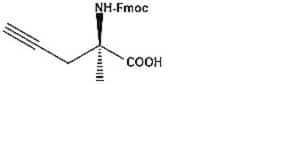
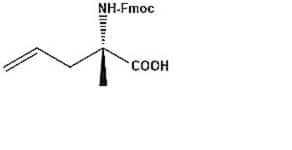
Fmoc-(R)-2-(2′-Propylenyl)alanine
- Catalog Number FA7105 Chemical Structure CAS Number 288617-76-5 Molecular Weight 351.40 g/mole Formula C21H21NO4
- Log in to view price and purchase
-
- Alkenyl Building Blocks for Stapled Peptides
Fmoc-(R)-2-(3′-Butenyl)alanine
- Catalog Number FA7135 Chemical Structure CAS Number 1311933-82-0 Molecular Weight 365.42 g/mole Formula C22H23NO4
- Log in to view price and purchase
-
- Alkenyl Building Blocks for Stapled Peptides
Fmoc-(R)-2-(3′-butenyl)glycine
- Catalog Number FG7135 Chemical Structure CAS Number 865352-21-2 Molecular Weight 351.40 g/mole Formula C21H21NO4
- Log in to view price and purchase
-
- Alkenyl Building Blocks for Stapled Peptides
Fmoc-(R)-2-(4-pentenyl)alanine
- Catalog Number FA7115 Chemical Structure CAS Number 288617-77-6 Molecular Weight 379.45g/mole Formula C23H25NO4
- Log in to view price and purchase
-
- Alkenyl Building Blocks for Stapled Peptides
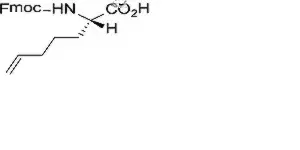
Fmoc-(R)-2-(4′-pentenyl)glycine
- Catalog Number FG7115 Chemical Structure CAS Number 1093645-21-6 Molecular Weight 365.42 g/mole Formula C22H23NO4
- Log in to view price and purchase
-
- Alkenyl Building Blocks for Stapled Peptides
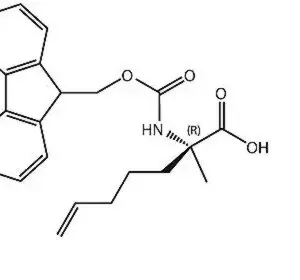
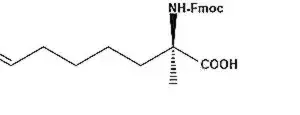
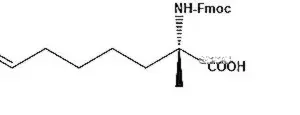
Fmoc-(R)-2-(5′-Hexenyl)alanine
- Catalog Number FA7145 Chemical Structure CAS Number 288617-78-7 Molecular Weight 393.48 g/mole Formula C24H27NO4
- Log in to view price and purchase
-
- Alkenyl Building Blocks for Stapled Peptides
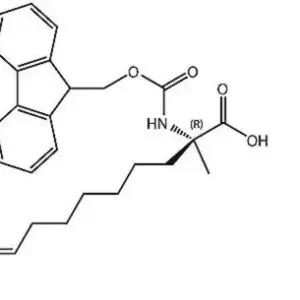
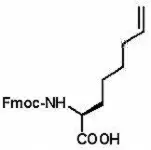
Fmoc-(R)-2-(7-octenyl)alanine
- Catalog Number FA7125 Chemical Structure CAS Number 945212-26-0 Molecular Weight 421.53g/mole Formula C26H31NO4
- Log in to view price and purchase
-
- Alkenyl Building Blocks for Stapled Peptides
Fmoc-(S)-2-(2′-Propylenyl)alanine
- Catalog Number FA7100 Chemical Structure CAS Number 288617-71-0 Molecular Weight 351.40 g/mole Formula C21H21NO4
- Log in to view price and purchase
-
- Alkenyl Building Blocks for Stapled Peptides
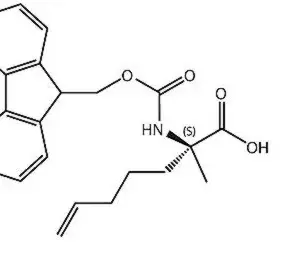
Fmoc-(S)-2-(4-pentenyl)Alanine – Alkenyl Amino Acid for Stapled Peptide
- Fmoc-(S)-2-(4-pentenyl)Alanine has been developed as a building block for the purpose of preparing stapled peptides via transition metal catalyzed ring closing metathesis. Stapled peptides showed enhanced stability, cell penetrating ability and target affinity, which greatly increases the chances for peptide drug discovery. See prices below. PubChem Compound Summary Catalog Number FA7110 Subclass Of chemical compound InChIKey MRJFPZWLOJOINV-QHCPKHFHSA-N CAS Registry Number…
- Log in to view price and purchase
-
- Alkenyl Building Blocks for Stapled Peptides
Fmoc-(S)-2-(4′-pentenyl)glycine
- Catalog Number FG7110 Chemical Structure CAS Number 856412-22-1 Molecular Weight 365.42 g/mole Formula C22H23NO4
- Log in to view price and purchase
-
- Alkenyl Building Blocks for Stapled Peptides
Fmoc-(S)-2-(5′-Hexenyl)alanine
- Catalog Number FA7140 Chemical Structure CAS Number 288617-74-3 Molecular Weight 393.48 g/mole Formula C24H27NO4
- Log in to view price and purchase
-
- Alkenyl Building Blocks for Stapled Peptides
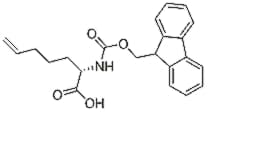
Fmoc-(S)-2-(5′-Hexenyl)glycine
- Catalog Number FG7140 Chemical Structure CAS Number 1251904-51-4 Molecular Weight 365.42 g/mole Formula C22H23NO4
- Log in to view price and purchase