
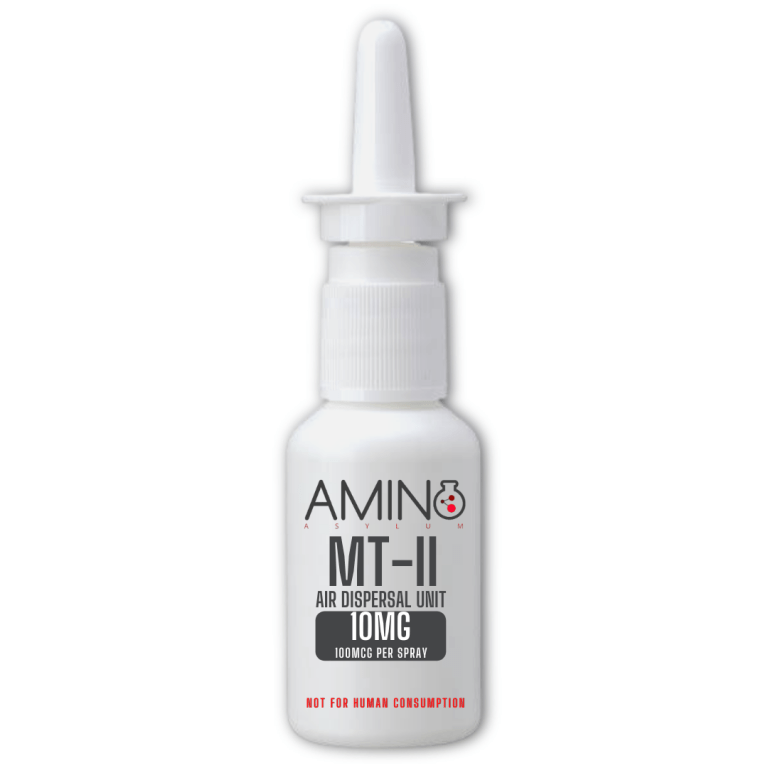
MT-II Spray
$54.99
MT-II Spray is a convenient Melanotan II peptide formulation for controlled research involving melanin production, pigmentation pathways, and melanocortin receptor activity.
Description
MT-II Spray (Melanotan II): Advanced Melanocortin Receptor Research & Intranasal Guide
In modern biochemical, physiological, and dermatological research, synthetic melanocortin receptor agonists represent a primary avenue for investigating melanogenesis, neuroendocrine signaling, and central autonomic regulation. Among these non-selective peptide analogs, MT-II Spray (Melanotan II Intranasal Solution) has emerged as an essential reference standard for evaluating trans-mucosal drug delivery systems and multi-receptor activation profiles.
Designed to overcome the necessity of parenteral injection in preclinical setups, non-invasive intranasal formulations provide predictable pharmacokinetic curves and sustained biological activity. For laboratory teams preparing to buy MT-II Spray for rigorous empirical trials, acquiring analytical-grade reagents with verified sequence purity is fundamental to maintaining baseline accuracy and reproducible data.
What is MT-II Spray (Melanotan II Nasal Solution)?
Melanotan II is a synthetic lactam cyclic analog of the naturally occurring peptide $\alpha$-Melanocyte Stimulating Hormone ($\alpha$-MSH). Originally synthesized at the University of Arizona to develop photoprotective agents against UV-induced damage, the peptide possesses the chemical structure Ac-Nle-cyclo[Asp-His-D-Phe-Arg-Trp-Lys]-NH2.
While historical trials relied predominantly on subcutaneous administration, modern non-invasive research protocols utilize MT-II nasal Spray. Delivered via an atomized micro-droplet liquid matrix, the peptide migrates across vascularized nasal turbinates into systemic circulation and central pathways.
                        [ Intranasal MT-II Spray ]
                                    │
               (Trans-Mucosal Migration / Nasal Epithelium)
                                    │
         ┌──────────────────────────┴──────────────────────────┐
         ▼                                                     ▼
[ Peripheral Systemic Entry ]                        [ Central CNS Access ]
         │                                                     │
         ▼                                                     ▼
[ MC1R Binding: Melanocytes ]                       [ MC3R / MC4R Binding ]
         │                                                     │
         └──────────────────────────┬──────────────────────────┘
                                    ▼
                [ Eumelanin Synthesis & Autonomic Output ]
Structural Chemistry: Cyclic Heptapeptide Architecture
The physical stability and high receptor binding affinity of Melanotan II stem directly from its cyclic structure:
-
Cyclic Lactam Bridge: The covalent bond between the side chains of Aspartic Acid ($\text{Asp}^3$) and Lysine ($\text{Lys}^8$) creates a rigid ring conformation, conferring resistance against enzymatic cleavage by serum endopeptidases.
-
$D$-Amino Acid Substitution: Replacing $L$-Phenylalanine with $D$-Phenylalanine ($\text{D-Phe}^6$) significantly increases potency at melanocortin receptors compared to native $\alpha$-MSH.
Chemical Specifications Reference:
• Sequence: Ac-Nle-cyclo[Asp-His-D-Phe-Arg-Trp-Lys]-NH2
• Molecular Formula: C50H69N15O9
• Molecular Weight: 1024.18 g/mol
• CAS Number: 121062-08-6
• Physical Form: Aqueous buffered intranasal spray solution
• Storage Parameters: Refrigerated (2°C - 8°C), sheltered from UV light
Comparing Subcutaneous Injection vs. MT-II Nasal Spray
| Parameter | Subcutaneous Injection | MT-II Spray (Intranasal) |
| Administration Modality | Invasive Parenteral | Non-Invasive Trans-Mucosal |
| First-Pass Hepatic Bypass | Yes | Yes |
| Peak Concentration ($T_{\max}$) | Rapid ($15 – 30\text{ min}$) | Steady ($30 – 60\text{ min}$) |
| Reconstitution Requirement | Requires Bacteriostatic Water | Pre-Formulated Ready-to-Use Liquid |
| Subject Compliance in Trials | Lower (Needle Stress) | High (Simple Metered Spray) |
Mucosal Membrane Permeability and Trans-Epithelial Absorption
The nasal respiratory epithelium presents a thin, highly vascularized barrier. Because MT II Spray possesses an optimized molecular weight ($1024.18\text{ g/mol}$) and balanced lipophilicity due to $N$-terminal acetylation, it passes efficiently across epithelial tight junctions via paracellular and transcellular pathways.
Proteolytic Stability and Solution Formulation Dynamics
To maintain molecular integrity in aqueous spray matrices, the solution must be buffered at an optimal osmotic pressure and pH range ($6.0 – 7.0$). This prevents hydrolytic cleavage of the lactam ring during storage.
Melanocortin Receptor Binding Profiles of MT II Spray
Melanotan II acts as a potent, non-selective agonist across multiple melanocortin receptor subtypes ($\text{MC1R}$, $\text{MC3R}$, $\text{MC4R}$, and $\text{MC5R}$).
                             [ MT-II Spray ]
                                    │
     ┌──────────────────┬───────────┴───────────┬──────────────────┐
     ▼                  ▼                       ▼                  ▼
  [ MC1R ]           [ MC3R ]                [ MC4R ]           [ MC5R ]
  (High)             (Moderate)              (High)             (Moderate)
     │                                          │
     ▼                                          ▼
[ Melanogenesis / ]                   [ Central Autonomic & ]
[ Eumelanin Synthesis ]               [ Metabolic Signaling ]
MC1R Stimulation and Melanogenesis Signaling Cascades
The Melanocortin-1 Receptor ($\text{MC1R}$) is primarily expressed on the surface of epidermal melanocytes:
-
Receptor Engagement: Binding of MT-II Spray to $\text{MC1R}$ triggers conformational changes that activate intracellular Heterotrimeric G-proteins ($\text{G}_s$).
-
Adenylate Cyclase Activation: Elevates intracellular Cyclic Adenosine Monophosphate ($\text{cAMP}$) levels.
-
Protein Kinase A ($\text{PKA}$) Pathway: Activates Microphthalmia-Associated Transcription Factor ($\text{MITF}$).
-
Tyrosinase Upregulation: Increases transcription of tyrosinase, converting $L$-tyrosine to dopaquinone, driving the predominant synthesis of photoprotective eumelanin over pheomelanin.
MC3R/MC4R Activation and Central Autonomic Pathways
Central melanocortin receptors ($\text{MC3R}$ and $\text{MC4R}$) situated within the paraventricular nucleus ($\text{PVN}$) of the hypothalamus regulate energy balance, metabolic rate, and autonomic signaling. Activation of central $\text{MC4R}$ pathways by intranasal administration mediates downstream neuroendocrine responses, making it a critical focus in neurochemical research.
Key Research Applications and Experimental Horizons
Photoprotective Mechanisms and Eumelanin Synthesis
In dermatological models, the production of eumelanin driven by $\text{MC1R}$ stimulation provides a chemical barrier against ionizing ultraviolet radiation ($\text{UVA/UVB}$). Eumelanin dissipates up to $99.9\%$ of absorbed UV radiation as heat, minimizing DNA pyrimidine dimer formation and oxidative stress in keratinocytes.
Central Nervous System and Peripheral Metabolic Observations
Preclinical studies examining central melanocortin activation demonstrate that systemic or central administration of Melanotan II influences:
-
Appetite and Satiety Signaling: Central $\text{MC4R}$ activation suppresses food intake in rodent models via hypothalamic pro-opiomelanocortin ($\text{POMC}$) neuron pathways.
-
Metabolic Rate and Lipid Oxidation: Enhances peripheral insulin sensitivity and brown adipose tissue ($\text{BAT}$) thermogenesis.
Comparative Analysis & Synergistic Research Stacks
Modern multi-pathway investigation often evaluates melanocortin analogs alongside other central peptide and cognitive modulators to map overlapping physiological networks.
                      [ Multi-Pathway Research Protocol ]
                                       │
     ┌─────────────────────────────────┼─────────────────────────────────┐
     ▼                                 ▼                                 ▼
[ Melanocortin Pathways ]     [ Neuropeptide Modulators ]      [ Metabolic / Bioenergetic ]
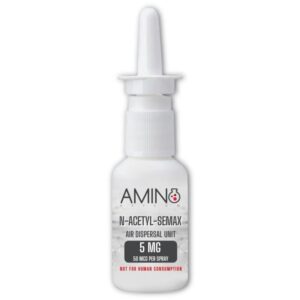
  • MT-II Spray                 • N-Acetyl-Semax Spray           • NAD+ Spray
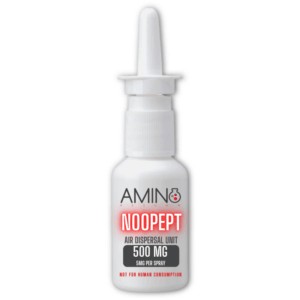
  • PT-141 Spray                • N-Acetyl-Selank Spray          • Buy Noopept
Melanocortin Receptor Analogs: Comparing MT-II Spray with PT-141 Spray
While Melanotan II is a non-selective agonist acting strongly on $\text{MC1R}$, $\text{MC3R}$, and $\text{MC4R}$, its derivative Bremelanotide focuses primarily on central pathways. Researchers studying central melanocortin responses without heavy dermal melanogenesis often compare outcomes using targeted formulations like PT-141 Spray.
Multi-Pathway Protocols: Integrating Buy Noopept, NAD+ Spray, N-Acetyl-Semax Spray, and N-Acetyl-Selank Spray
Complex neuro-chemical protocols evaluate metabolic energy, cognitive modulation, and central signaling simultaneously:
-
Cognitive and Receptor Sensitization: Combining melanocortin agonists with central dipeptides—such as when research teams choose to Buy Noopept—allows for simultaneous monitoring of $\text{AMPA}$ receptor activity and hypothalamic output.
-
Cellular Bioenergetics: Co-administering cellular coenzymes such as NAD+ Spray provides critical insights into intracellular $\text{ATP}$ generation and mitochondrial health during acute metabolic shifts.
-
Neuropeptide Signaling & Neuroprotective Modulation: Integrating central neuropeptides such as N-Acetyl-Semax Spray and anxiolytic modulators like N-Acetyl-Selank Spray enables researchers to evaluate neurotrophin ($\text{BDNF/NGF}$) expression and stress response mechanisms concurrently.
Sourcing Premium Research Peptides to Buy MT-II Spray Online
When preparing to buy MT-II Spray for laboratory trials, verifying chemical purity and batch stability is paramount to prevent experimental artifacts.
Certificate of Analysis (COA) & High-Performance Liquid Chromatography (HPLC)
Every analytical reagent must be backed by transparent laboratory testing documentation. Key parameters include:
-
High-Performance Liquid Chromatography (HPLC): Confirms chemical purity ($\ge 98\%$) and identifies potential peptide cleavage products.
-
Mass Spectrometry (MS): Confirms exact molecular mass ($1024.18\text{ g/mol}$).
Laboratory Quality Notice: Researchers sourcing reference materials from amino asylum receive fully tested, analytical-grade compounds packaged to ensure maximum structural stability across experimental trials.
Why Laboratories Rely on Amino Asylum for Reference Compounds
At Amino Asylum, product synthesis follows strict quality assurance standard operating procedures. Pre-formulated intranasal solutions are prepared in sterile, buffered matrices to protect molecular integrity and provide precise volumetric delivery per actuation.
Frequently Asked Questions (FAQ)
What Is the Difference Between MT II Spray and PT-141 Formulations?
Melanotan II (MT II Spray) is a broad non-selective melanocortin agonist that stimulates both $\text{MC1R}$ (dermal melanogenesis) and central $\text{MC3R/MC4R}$ receptors. PT-141 (Bremelanotide) is a metabolite of MT-II refined specifically to target central $\text{MC3R/MC4R}$ receptors with minimal $\text{MC1R}$ activity.
How Should MT-II Nasal Spray Be Stored to Maintain Compound Integrity?
Refrigerate liquid spray bottles between $2^\circ\text{C}$ and $8^\circ\text{C}$. Keep the container tightly sealed and protected from direct sunlight or UV exposure to prevent hydrolytic degradation.
What Is the Standard Concentration in Metered MT-II Spray Solutions?
Standard laboratory sprayers dispense precise micro-metered volumes (e.g., $100\text{ \mu L}$ per pump actuation delivering a calibrated concentration of active peptide per spray).
Final Verdict: Where to Buy MT-II Spray for Research
Investigating melanocortin receptor mechanics, melanogenesis signaling, and central autonomic regulation requires stable, analytical-grade reagents. Utilizing MT-II Spray provides an effective, non-invasive methodology for delivering Melanotan II across vascularized mucosal membranes in laboratory settings.
When evaluating vendors to buy MT-II Spray or sourcing high-purity MT-II nasal Spray solutions, amino asylum stands out as a trusted supplier of lab-tested research chemicals. Ensure clean, reproducible outcomes for your scientific trials by sourcing fully verified reagents for your laboratory protocols.
Related products
-
- SPRAYS
N-Acetyl-Selank Spray
- Log in to view price and purchase
-
- SPRAYS
N-Acetyl-Semax Spray
- Log in to view price and purchase
-
- SPRAYS
Buy Noopept
- Log in to view price and purchase
Reviews
There are no reviews yet.