
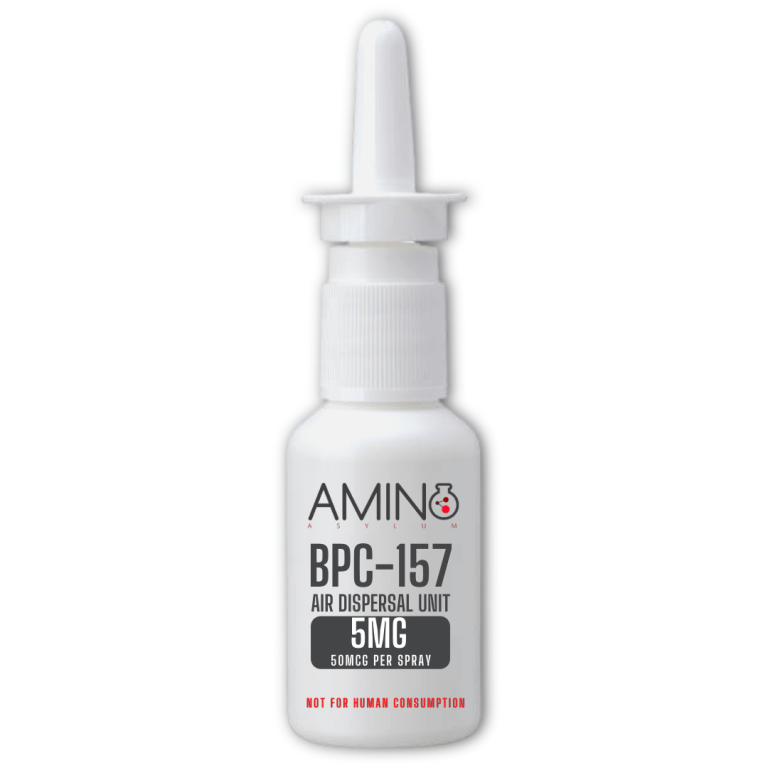
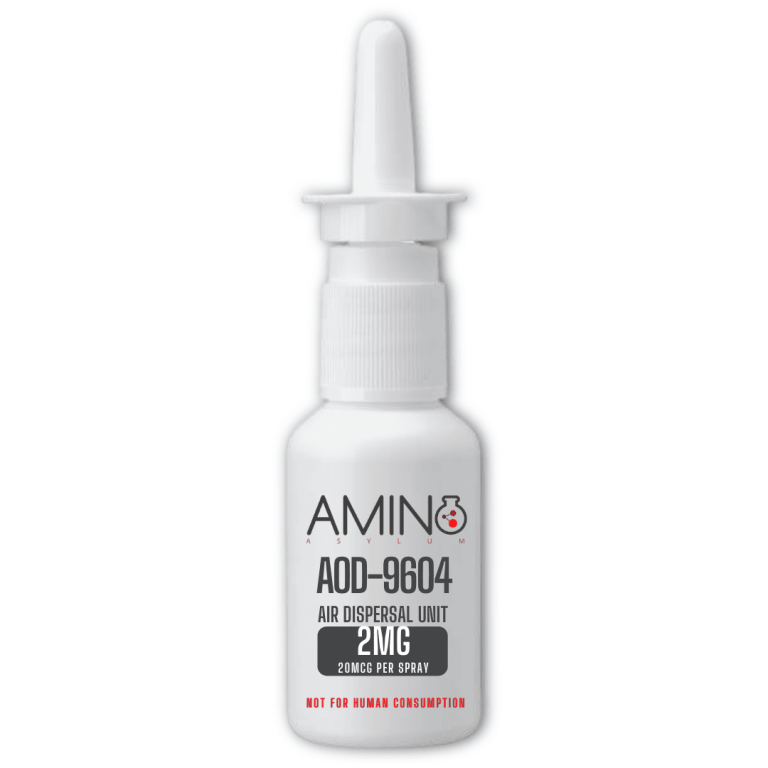
AOD-9604 Spray
$79.99
A convenient AOD-9604 peptide formulation for research involving fat metabolism, lipolysis, body composition, and metabolic pathways.
Description
AOD-9604 Spray: Advanced Lipolytic Peptide Research & Intranasal Guide
In metabolic biochemistry, endocrinology, and obesity research, synthetic fragments of Human Growth Hormone ($\text{hGH}$) represent a critical area of study for isolating lipolytic activity from systemic somatotropic signaling. Among these specialized modified peptides, AOD-9604 Spray has emerged as a premier reference standard for investigating targeted adipocyte lipid breakdown, non-glycemic metabolic regulation, and cartilage chondrogenesis.
Engineered to eliminate the diabetogenic and anabolic side effects associated with full-length $\text{hGH}$, intranasal formulations of AOD-9604 offer researchers an efficient, non-invasive administration route. Incorporating an AOD-9604 NASAL Spray into experimental protocols allows laboratories to observe steady systemic absorption and tissue distribution without requiring invasive parenteral injections.
What is AOD-9604 Spray (Advanced Anti-Obesity Drug Peptide)?
AOD-9604 (Advanced Anti-Obesity Drug 9604) is a synthetic modified hexadecapeptide analog derived from the $C$-terminal region of human growth hormone ($\text{hGH}_{177-191}$), featuring an additional $N$-terminal tyrosine residue. Its structural peptide sequence is expressed as:
Originally designed by researchers at Monash University to isolate the fat-reducing properties of growth hormone, this peptide targets lipid metabolism directly. By utilizing an atomized AOD-9604 NOSE Spray solution, active peptide molecules are delivered across vascularized nasal turbinates directly into systemic capillaries, bypassing first-pass hepatic degradation and gastrointestinal enzymatic breakdown.
                      [ Intranasal AOD-9604 Spray ]
                                    │
               (Trans-Mucosal Migration / Nasal Epithelium)
                                    │
         ┌──────────────────────────┴──────────────────────────┐
         ▼                                                     ▼
[ Peripheral Systemic Entry ]                        [ Micro-Capillary Distribution ]
         │                                                     │
         ▼                                                     ▼
[ Adipocyte β3-AR Stimulation ]                     [ Chondrocyte ECM Repair ]
         │                                                     │
         └──────────────────────────┬──────────────────────────┘
                                    ▼
           [ Upregulated Lipolysis & Lipogenesis Inhibition ]
Molecular Chemistry: C-Terminal Fragment 177-191 Architecture
The unique biological functionality of AOD-9604 depends on its precise intramolecular disulfide bridging and chemical sequence modifications:
-
Disulfide Loop Conformation: A covalent disulfide bond between Cysteine residues ($\text{Cys}^7-\text{Cys}^{14}$) creates a stable cyclic loop structure, which is essential for binding specific lipolytic cell surface domains.
-
$N$-Terminal Tyrosine Modification: Adding a tyrosine residue at the $N$-terminus increases structural stability and prevents rapid exopeptidase degradation in systemic circulation.
Chemical Specifications Reference:
• Sequence: Tyr-Leu-Arg-Ile-Val-Gln-Cys-Arg-Ser-Val-Glu-Gly-Ser-Cys-Gly-Phe (Disulfide bridge: 7-14)
• Molecular Formula: C78H123N23O23S2
• Molecular Weight: 1815.08 g/mol
• CAS Number: 221231-10-3
• Physical Form: Aqueous buffered intranasal spray solution
• Storage Parameters: Refrigerated (2°C - 8°C), sheltered from UV light
Comparing Subcutaneous Injections vs. AOD-9604 NASAL Spray
| Parameter | Subcutaneous Injection | AOD-9604 NASAL Spray |
| Administration Route | Invasive Parenteral | Non-Invasive Trans-Mucosal |
| First-Pass Hepatic Bypass | Yes | Yes |
| Gastrointestinal Breakdown | None | Bypassed Completely |
| Reconstitution Requirement | Manual (Bacteriostatic Water) | Pre-Formulated Ready-to-Use Solution |
| Subject Compliance in Trials | Lower (Injection Anxiety) | High (Simple Atomized Delivery) |
Trans-Mucosal Membrane Uptake and Systemic Bioavailability
The respiratory nasal mucosa features a thin endothelial membrane with rich vascularization. Administering an AOD-9604 NASAL Spray enables rapid micro-droplet diffusion through paracellular spaces into systemic micro-capillaries, delivering active peptide to target adipose tissue beds without the mechanical stress of needle injections.
Enzymatic Stability and Non-Glycemic Receptor Activation
Full-length growth hormone ($\text{hGH}$) often induces insulin resistance and hyperglycemia by engaging hepatic growth hormone receptors. AOD-9604 operates through an independent pathway that does not bind standard $\text{hGH}$ receptors, preserving normal glucose homeostasis and circulating insulin sensitivity during research trials.
Biological Mechanisms of Action in Metabolic Research
                          [ AOD-9604 Spray ]
                                  │
     ┌────────────────────────────┴────────────────────────────┐
     ▼                                                         ▼
[ β3-Adrenergic Receptor Triggering ]               [ Acetyl-CoA Carboxylase Inhibition ]
     │                                                         │
     ▼                                                         ▼
[ Adenylate Cyclase Activation / cAMP Rise ]        [ Prevention of Free Fatty Acid Storage ]
     │                                                         │
     ▼                                                         ▼
[ Hormone-Sensitive Lipase (HSL) Release ]          [ Blunted Adipocyte Hypertrophy ]
     │                                                         │
     └────────────────────────────┬────────────────────────────┘
                                  ▼
                   [ Net Adipose Mass Reduction ]
Beta-3 Adrenergic Receptor Activation and Lipolysis Dynamics
AOD-9604 mimics the natural lipolytic action of full-length $\text{hGH}$ by interacting with $\beta_3$-adrenergic receptors ($\beta_3\text{-AR}$) on adipocyte membranes:
-
Receptor Signaling Cascade: Binding to $\beta_3\text{-AR}$ activates intracellular Adenylate Cyclase, raising Cyclic Adenosine Monophosphate ($\text{cAMP}$) levels.
-
Lipase Activation: Elevated $\text{cAMP}$ triggers Protein Kinase A ($\text{PKA}$), which phosphorylates and activates Hormone-Sensitive Lipase ($\text{HSL}$).
-
Triglyceride Hydrolysis: Active $\text{HSL}$ hydrolyzes stored intracellular triglycerides into glycerol and free fatty acids ($\text{FFAs}$) for mitochondrial $\beta$-oxidation.
Inhibition of Lipogenesis and Adipocyte Lipid Accumulation
Beyond accelerating fat breakdown (lipolysis), AOD-9604 Spray inhibits lipogenesis—the metabolic process that synthesizes and stores new fat:
-
Enzyme Regulation: It downregulates key lipogenic enzymes, specifically Acetyl-$\text{CoA}$ Carboxylase ($\text{ACC}$) and Fatty Acid Synthase ($\text{FAS}$).
-
Adipocyte Hypertrophy Prevention: By preventing the uptake of circulating glucose and fatty acids into pre-adipocytes, it stops immature fat cells from enlarging.
Key Research Applications and Cartilage Chondrogenesis
Adipose Tissue Reduction Without IGF-1 Upregulation
A major limitation of full-length growth hormone in long-term research is its stimulation of Insulin-like Growth Factor 1 ($\text{IGF-1}$) from the liver, which can cause unwanted systemic tissue proliferation. Studies demonstrate that AOD-9604 NOSE Spray stimulates lipolysis without raising serum $\text{IGF-1}$ levels, allowing researchers to study fat loss in isolation from somatic growth pathways.
Joint Health Horizons and Extracellular Matrix Repair
In addition to its metabolic properties, AOD-9604 exhibits regenerative capabilities in musculoskeletal and joint research models:
-
Chondrocyte Proliferation: Promotes the migration and differentiation of articular chondrocytes.
-
Extracellular Matrix ($\text{ECM}$) Synthesis: Upregulates proteoglycan and Collagen Type II expression, making it a valuable target in joint degeneration and cartilage repair studies.
Comparative Analysis & Synergistic Research Stacks
Complex metabolic and regenerative protocols frequently integrate lipolytic fragments alongside antioxidants, tissue-repair peptides, and central neuropeptides.
                      [ Multi-Pathway Research Protocol ]
                                       │
     ┌─────────────────────────────────┼─────────────────────────────────┐
     ▼                                 ▼                                 ▼
[ Metabolic / Lipolytic ]     [ Cellular Energy & Repair ]     [ Cognitive / Neuropeptides ]
  • AOD-9604 Spray              • BPC-157 Spray                  • N-Acetyl-Semax Spray
                                • glutathione spray              • N-Acetyl-Selank Spray
                                • NAD+ Spray                     • Buy Noopept
                                                                 • PT-141 Spray / MT-II Spray
Metabolic & Tissue Repair Stacks: Pairing AOD-9604 Spray with BPC-157 Spray, Glutathione Spray, and NAD+ Spray
Integrating metabolic peptides with tissue-protective and antioxidant agents creates a balanced research environment:
-
Tissue Repair Synergy: Pairing lipolytic compounds with regenerative peptides like BPC-157 Spray allows laboratories to evaluate joint remodeling and extracellular matrix repair alongside active lipolysis.
-
Antioxidant Defense: Combining protocols with glutathione spray neutralizes reactive oxygen species ($\text{ROS}$) produced during accelerated fatty acid $\beta$-oxidation.
-
Mitochondrial Bioenergetics: Co-administering metabolic catalysts like NAD+ Spray supports cellular energy production ($\text{ATP}$) required for lipid turnover and chondrocyte repair.
Multi-Pathway Protocols: Integrating Buy Noopept, PT-141 Spray, MT-II Spray, N-Acetyl-Semax Spray, and N-Acetyl-Selank Spray
Broad-spectrum physiological research often combines metabolic fragment studies with central neurological modulators:
-
Cognitive Modulation: Pairing metabolic research with central dipeptides—such as when research teams choose to Buy Noopept—allows for simultaneous monitoring of $\text{AMPA}$ receptor sensitization and metabolic signaling.
-
Melanocortin Activation: Integrating central neuroendocrine agonists like PT-141 Spray or broader non-selective options like MT-II Spray enables multi-system studies into autonomic output and energy expenditure.
-
Neuropeptide Dynamics: Combining metabolic protocols with central neuropeptides such as N-Acetyl-Semax Spray and anxiolytic modulators like N-Acetyl-Selank Spray allows researchers to monitor $\text{BDNF/NGF}$ expression during systemic metabolic shifts.
Sourcing Premium Research Compounds to Buy AOD-9604 NOSE Spray Online
When acquiring an AOD-9604 Spray for laboratory trials, verifying peptide sequence accuracy and structural integrity is critical to obtaining clean, reproducible data.
Certificates of Analysis (COA) & High-Performance Liquid Chromatography (HPLC)
Analytical testing documentation ensures that research products are free from truncated peptide sequences or chemical impurities. Key quality parameters include:
-
High-Performance Liquid Chromatography (HPLC): Confirms structural sequence purity ($\ge 98\%$).
-
Mass Spectrometry (MS): Verifies exact molecular weight ($1815.08\text{ g/mol}$) and proper disulfide bond formation ($\text{Cys}^7-\text{Cys}^{14}$).
Quality Standard: Researchers sourcing reference compounds through amino asylum receive high-purity, third-party verified materials formulated in osmotic-balanced matrices for reliable volumetric delivery.
Why Scientific Laboratories Rely on Amino Asylum for Reference Standards
At Amino Asylum, product synthesis follows rigorous quality control standards. Intranasal liquid formulations are prepared in sterile, buffered delivery matrices engineered to protect peptide stability and prevent hydrolytic cleavage during storage.
Frequently Asked Questions (FAQ)
What Is the Difference Between Subcutaneous Injectables and AOD-9604 NOSE Spray?
Subcutaneous administration requires manual reconstitution and parenteral injection. An AOD-9604 NOSE Spray provides a pre-formulated, non-invasive alternative that utilizes vascularized nasal mucosa for systemic absorption.
How Does AOD-9604 NASAL Spray Avoid Affecting Blood Glucose Levels?
Unlike full-length $\text{hGH}$, AOD-9604 lacks the $N$-terminal domain responsible for inducing insulin resistance. It acts specifically on adipocyte $\beta_3$-adrenergic receptors, leaving blood glucose and systemic $\text{IGF-1}$ levels unchanged.
How Should AOD-9604 Spray Solutions Be Stored to Maintain Stability?
Refrigerate liquid spray bottles upright at $2^\circ\text{C}$ to $8^\circ\text{C}$. Keep solutions protected from direct UV light and excessive heat to prevent peptide bond breakdown.
Final Verdict: Sourcing High-Purity AOD-9604 Spray for Research
Investigating lipolytic pathways, lipid metabolism, and cartilage repair requires stable, analytical-grade compounds. Utilizing AOD-9604 Spray offers an efficient, non-invasive delivery method for evaluating the $\text{hGH}_{177-191}$ hexadecapeptide fragment in preclinical models.
When sourcing AOD-9604 NASAL Spray or AOD-9604 NOSE Spray for upcoming laboratory trials, amino asylum provides batch-tested, high-purity research chemicals backed by analytical verification and rapid fulfillment. Ensure consistency and precision in your scientific research by equipping your lab with verified reference materials.
Related products
-
- SPRAYS
BPC-157 Spray
- Log in to view price and purchase
-
- SPRAYS
MT-II Spray
- Log in to view price and purchase
-
- SPRAYS
N-Acetyl-Selank Spray
- Log in to view price and purchase
Reviews
There are no reviews yet.