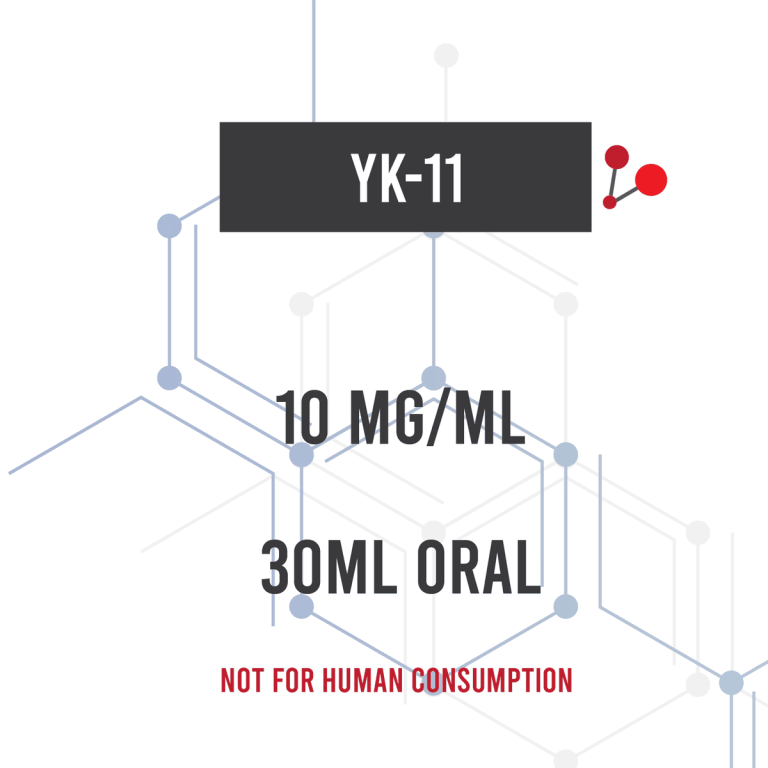
YK-11 10MG X 30ML
$39.99
YK-11 10MG X 30ML is a liquid research formulation for controlled studies involving androgen receptors, follistatin, myostatin pathways, and muscle-related signaling.
Description
YK-11 10mg/ml 30ml (CAS 1370003-76-1): Advanced Research Chemical Guide
In molecular biology, endocrinology, and cellular research, investigating compounds capable of modulating androgen receptor signaling while simultaneously altering gene expression pathways represents a vital field of study. Among specialized research ligands, YK-11 10mg/ml 30ml (CAS 1370003-76-1) stands out due to its dual functional profile as a partial agonist of the androgen receptor ($\text{AR}$) and an inducer of follistatin expression.
Unlike standard non-steroidal Selective Androgen Receptor Modulators (SARMs), YK-11 possesses a unique steroidal backbone that exhibits gene-selective transcription kinetics. For empirical research facilities seeking to evaluate YK-11 CAS 1370003-76-1 price standards and secure a verified buy YK-11 10mg/ml liquid supplier, sourcing analytical-grade reference solutions from amino asylum ensures high volumetric accuracy, structural purity, and reproducible batch-to-batch data.
What is YK-11 10mg/ml 30ml Solution?
YK-11 10mg/ml 30ml is a pre-formulated, liquid-suspended reference chemical solution containing $10\text{ mg}$ of active synthetic compound per milliliter of specialized carrier solvent ($300\text{ mg}$ total content per bottle).
Chemically designated as $(17\alpha,20E)-17,20-[(\text{1-methoxyethylidene})\text{bis}(\text{oxy})]-3\text{-oxo-19-norpregna-4,20-diene-21-carboxylic acid methyl ester}$, YK-11 features a modified 19-norsteroid core appended with ester functionality. This unique molecular architecture separates its pathway activation metrics from conventional non-steroidal ligands like ostabolic or anabolic-androgenic steroid controls.
                     [ YK-11 Multi-Pathway Signaling Network ]
                                        │
        ┌───────────────────────────────┼───────────────────────────────┐
        ▼                               ▼                               ▼
[ Steroidal 19-Nor Core ]       [ Partial AR Agonism ]         [ Follistatin Gene Induction ]
(Modified Pregnadene Scaffold)  (Nuclear Receptor Binding)     (Upregulated FST Protein Expression)
        │                               │                               │
        ▼                               ▼                               ▼
 High Volumetric Stability      Gene Transcription Modulation   Myostatin (GDF-8) Antagonism
 in Liquid Carriers             in Target Tissue Cultures       in Myoblast Cell Models
Molecular Architecture & Chemical Identity of CAS 1370003-76-1
The chemical parameters of CAS 1370003-76-1 establish its analytical identity across research applications:
Chemical Specifications Reference:
• Full Chemical IUPAC Name: (17α,20E)-17,20-[(1-methoxyethylidene)bis(oxy)]-3-oxo-19-norpregna-4,20-diene-21-carboxylic acid methyl ester
• CAS Registry Number: 1370003-76-1
• Molecular Formula: C25H34O6
• Molecular Weight: 430.54 g/mol
• Formulation Concentration: 10 mg/mL (30 mL total, 300 mg container volumetric capacity)
• Physical Form: Liquid suspension / pre-dissolved analytical solution
• Storage Parameters: Refrigerated (2°C - 8°C), desiccated, protected from light exposure
The Steroidal SARM Profile: Partial Agonism and Myostatin Expression Dynamics
Androgen Receptor (AR) Binding Affinity and Gene Transcription
Studies demonstrate that YK-11 binds to nuclear androgen receptors with high affinity. However, unlike full androgen agonists, its interaction with $\text{AR}$ produces a partial agonistic response, inducing key target gene transcriptions without inducing classical $\text{N/C}$ terminal interaction—a mechanism necessary for full androgenic signaling cascades in prostatic tissue models.
Up-Regulation of Follistatin Signal Cascades
The defining feature of YK-11 in cell culture models is its capacity to significantly upregulate Follistatin ($\text{FST}$) expression. Follistatin is an autocrine glycoprotein that acts as an endogenous antagonist to Myostatin (Growth Differentiation Factor 8, $\text{GDF-8}$), a negative regulator of muscle cell differentiation and hypertrophy.
| Property / Parameter | Standard Non-Steroidal SARMs | Traditional Anabolic Androgens | YK-11 10mg/ml 30ml |
| CAS Registry Number | Varied (e.g., 401900-40-1) | Varied (e.g., 58-18-4) | 1370003-76-1 |
| Backbone Architecture | Non-Steroidal Aryl Propionamide | 4-Ring Steroid Skeleton | Modified 19-Norsteroid Core |
| Myostatin Expression | Indirect / Minimal Modulation | Variable | Direct Follistatin Upregulation |
| AR Activation Mode | Selective Agonist | Full Agonist | Partial Agonist + FST Inducer |
| Solution Form | Powder / Liquid Solutes | Injectable Oil / Tablet | Volumetric Liquid (10mg/ml) |
Biological Mechanisms of YK-11 Research Chemical Bulk Manufacturer Compounds
                        [ In Vitro Myoblast Culture Model ]
                                         │
        ┌────────────────────────────────┴────────────────────────────────┐
        ▼                                                                 ▼
[ YK-11 Receptor Binding ]                                       [ Nuclear translocation ]
        │                                                                 │
        ▼                                                                 ▼
[ Transcription of FST Gene ]                                    [ Increased Secretion of Follistatin ]
        │                                                                 │
        ▼                                                                 ▼
[ Neutralization of GDF-8 (Myostatin) ]                          [ Uninhibited Myotube Formation ]
Myostatin (GDF-8) Inhibition Pathways in Muscle Cell Culture Models
In vitro investigations using C2C12 myoblast cultures indicate that adding compounds sourced from a YK-11 research chemical bulk manufacturer triggers a marked increase in follistatin production compared to baseline androgen controls:
-
Receptor Interaction: YK-11 occupies the androgen receptor ligand-binding domain ($\text{LBD}$).
-
Gene Activation: The ligand-receptor complex translocates to the nucleus, selectively binding androgen response elements ($\text{AREs}$) that regulate $\text{FST}$ transcription.
-
Paracrine Antagonism: Exported follistatin binds circulating $\text{GDF-8}$ (Myostatin) proteins, preventing them from engaging Activin type IIB receptors ($\text{ActRIIB}$) and downstream $\text{Smad2/3}$ phosphorylation.
Comparing Gene Expression Profiles: YK-11 vs. Traditional Non-Steroidal Ligands
Comparative genomic profiling assays demonstrate that while traditional non-steroidal ligands primarily induce myogenic differentiation markers (such as MyoD and Myogenin) through direct $\text{AR}$ transactivation, YK-11 exerts a dual effect by suppressing negative growth regulators alongside direct receptor signaling.
Analytical Quality Standards: What Is the Purity of YK-11 10mg/ml 30ml Liquid?
High-Performance Liquid Chromatography (HPLC) & Mass Spectrometry Protocols
When laboratories evaluate what is the purity of YK-11 10mg/ml 30ml liquid, rigorous analytical procedures are required to ensure freedom from degraded steroidal fragments, residual synthesis solvents, or unreacted intermediate precursors:
-
High-Performance Liquid Chromatography (HPLC): Confirms chemical purity ($\ge 98.0\%$) and establishes chromatographic retention time matching known reference standards.
-
Mass Spectrometry (MS): Confirms structural molecular weight ($430.54\text{ g/mol}$) and fragment ion spectra verification.
Carrier Solvent Dynamics, Volumetric Precision, and Liquid Solution Stability
Pre-formulated liquid solutions resolve dosing variance issues associated with unformulated dry powders:
-
Solvent Composition: Utilizes high-purity laboratory-grade solvents (PEG-400 / Ethanol matrices) engineered to maintain total solubility without compound precipitation.
-
Volumetric Accuracy: Formulated at exactly $10\text{ mg/mL}$, enabling researchers to measure precise micro-liter aliquots ($100\mu\text{L} = 1\text{ mg}$) for controlled in vitro assays.
Comparative Analysis & Catalog Integration
Comparing Steroidal Ligands with SPPS Reagents like Fmoc-N-Me-His(Trt)-OH
While steroidal ligands like YK-11 are studied for receptor transactivation and myostatin regulation, peptide synthesis laboratories employ protected amino acid derivatives—such as Fmoc-N-Me-His(Trt)-OH—to construct custom peptide chains with conformational stability. Both fields rely on structural modification principles to enhance molecular target specificity.
                      [ Reagent Sourcing to Finished Research ]
                                         │
     ┌───────────────────────────────────┼───────────────────────────────────┐
     ▼                                   ▼                                   ▼
[ Small Molecule Research ]     [ Stabilized Neuropeptides ]        [ Metabolic & Repair Compounds ]
 • YK-11 10mg/ml 30ml           • N-Acetyl-Semax Spray              • Buy Noopept
 • Custom Liquid Solutions      • N-Acetyl-Selank Spray             • NAD+ Spray
                                • PT-141 Spray / MT-II Spray        • glutathione spray
                                                                    • BPC-157 Spray / AOD-9604 Spray
From Molecular Research to Finished Formulations
Modern empirical research often integrates small-molecule pathway modulators with targeted neuropeptides, metabolic catalysts, and tissue repair agents:
-
Cognitive & Central Modulators: Research protocols investigating androgen signaling pathways often evaluate central nervous system modulators such as Buy Noopept.
-
Cellular Bioenergetics & Antioxidant Defense: In vitro cellular stress models frequently pair experimental compounds with cellular energy promoters like NAD+ Spray and intracellular scavengers like glutathione spray.
-
Tissue Repair & Lipolytic Signaling: Broader physiological modeling pairs receptor agonists with tissue repair peptides like BPC-157 Spray and metabolic fragments such as AOD-9604 Spray.
-
Melanocortin & Neuropeptide Pathways: Multi-system laboratory studies frequently run parallel assays utilizing melanocortin agonists like PT-141 Spray and MT-II Spray, as well as stabilized intranasal neuropeptides like N-Acetyl-Semax Spray and N-Acetyl-Selank Spray.
Sourcing Reagents: Where to Buy YK-11 10mg/ml 30ml Online
When procurement officers analyze where to buy YK-11 10mg/ml 30ml online, selecting a vendor that provides validated analytical standards and batch-tested materials is essential for experimental accuracy.
Evaluating YK-11 CAS 1370003-76-1 Price Structures and Market Standards
Market pricing for CAS 1370003-76-1 reflects raw material purity, carrier solvent quality, and third-party analytical verification. Cheap, unverified products often contain residual heavy metals, improper concentrations, or degraded active compounds that distort experimental outcomes.
Selecting a Verified Buy YK-11 10mg/ml Liquid Supplier at Amino Asylum
Procuring reference standards from a validated buy YK-11 10mg/ml liquid supplier like amino asylum ensures that research facilities receive high-purity, volumetric liquid solutions backed by strict quality control and analytical transparency.
Frequently Asked Questions (FAQ)
What Is the Exact IUPAC Nomenclature for YK-11 CAS 1370003-76-1?
The formal IUPAC name is $(17\alpha,20E)-17,20-[(\text{1-methoxyethylidene})\text{bis}(\text{oxy})]-3\text{-oxo-19-norpregna-4,20-diene-21-carboxylic acid methyl ester}$, indexed under CAS 1370003-76-1.
Why Is Liquid Suspension Solution Preferred Over Unformulated Powder for Volumetric Measuring?
Pre-formulated liquid solutions at $10\text{ mg/mL}$ eliminate micro-scale weighing errors, ensuring uniform compound distribution and accurate liquid aliquot measurement in laboratory settings.
How Should YK-11 10mg/ml 30ml Bottled Solutions Be Stored to Maintain Compound Stability?
Store liquid bottles upright in a cold environment ($2^\circ\text{C} – 8^\circ\text{C}$), sealed from air exposure and sheltered from direct sunlight or ambient ultraviolet light.
Final Verdict: Sourcing High-Purity YK-11 10mg/ml 30ml for Research
Investigating androgen receptor partial agonism, myostatin suppression pathways, and follistatin gene expression requires analytical-grade reference chemicals. YK-11 10mg/ml 30ml (CAS 1370003-76-1) provides the chemical precision necessary for high-level in vitro research.
When analyzing YK-11 CAS 1370003-76-1 price options or selecting a verified supplier for your laboratory, amino asylum delivers batch-verified purity, precise volumetric liquid solutions, and reliable fulfillment to support your scientific protocols.
Reviews
There are no reviews yet.